21 Double integrals I
Introduction
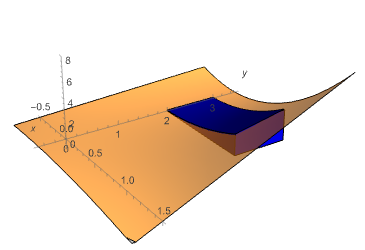
If \(f(x,y)\) is a function defined over a planar region \(R\), we can write \[ \iint_R f(x,y) \, dA \] for the volume of the solid under the graph of \(f\) and above \(R\): the double integral of \(f(x,y)\) over \(R\).
To define such a quantity, we need to partition \(R\) into small rectangles, then consider the limit of Riemann sums as the partition becomes finer—see (Stewart, Clegg, and Watson 2020, figs. 15.1.4–5).
As with a single variable, integrals have some nice properties that help us compute them. In particuar:
If \(f(x,y)\) and \(g(x,y)\) are continuous on a region \(R\) and \(a\) and \(b\) are constants, then \[ \iint_R \left( a f(x,y) + b g(x,y) \right) \, dA = a \iint_R f(x,y) dA + b \iint_R g(x,y) \, dA. \]
Main results
If \(f(x,y)\) is continuous on a rectangular region \(R = [a,b] \times [c,d]\), then \[ \iint_R f(x,y) \, dA = \int_a^b \left( \int_c^d f(x,y) \, dy \right) dx = \int_c^d \left( \int_a^b f(x,y) \, dx \right) dy. \]
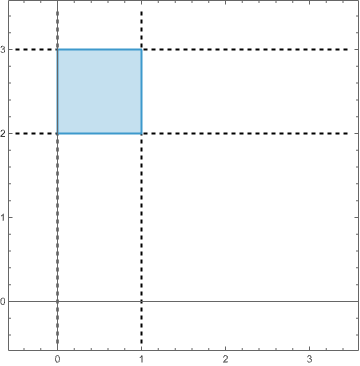
By Fubini’s theorem, we can compute this integral in two ways:
\[ \begin{split} \iint_R x^2 y \, dA & = \int_0^1 \int_2^3 x^2 y \, dy \, dx = \int_0^1 \tfrac{5}{2} x^2 \, dx = \tfrac{5}{6} \\ & = \int_2^3 \int_0^1 x^2 y \, dx \, dy = \int_2^3 \tfrac{1}{3} y \, dy = \tfrac{5}{6}. \end{split} \]
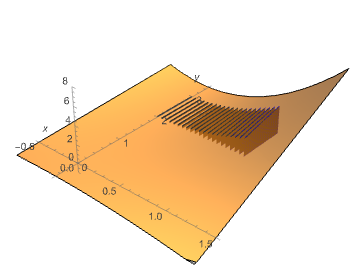
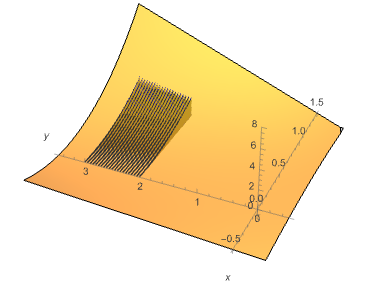
The first of these—where we hold \(x\) constant, integrate along \(y\), and then add up these slices in \(x\)—is shown in the first figure below; the second is the last figure.
You should practice these integrals by hand!—but you should also use Mathematica to check your work.
Integrate[
  x^2 y,
  {x, 0, 1},
  {y, 2, 3}
]
Holding \(x\) constant first: \(\int_0^1 \int_2^3 x^2 y \, dy \, dx\).
Integrate[
  x^2 y,
  {y, 2, 3},
  {x, 0, 1}
]
Holding \(y\) constant first: \(\int_2^3 \int_0^1 x^2 y \, dx \, dy\).
If we can factor \(f(x,y) = g(x)h(y)\), then \[ \iint_R g(x)h(y) \, dA = \left( \int_a^b g(x) \, dx \right) \left( \int_c^d h(y) \, dy \right). \]
More interesting regions
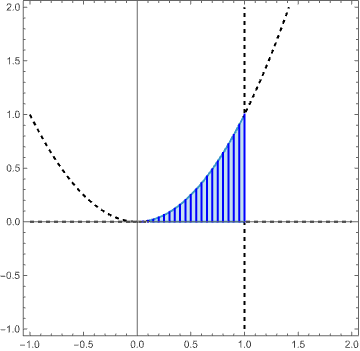
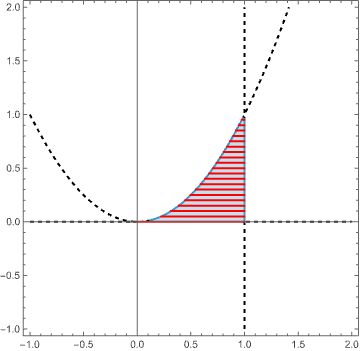
We check both ways of computing the integral:
\[ \begin{split} \iint_R (x+y) \, dA & = \int_0^1 \int_0^{x^2} (x+y) \, dy \, dx = \int_0^1 (\tfrac{1}{2} x^4 + x^3) \, dx = \tfrac{7}{20} \\ & = \int_0^1 \int_{\sqrt{y}}^1 (x+y) \, dx \, dy = \int_0^1 (-y^{3/2} + \tfrac{1}{2}y + \tfrac{1}{2} ) \, dy = \tfrac{7}{20}. \end{split} \]
Is it easier to hold \(x\) constant first or \(y\) constant first?
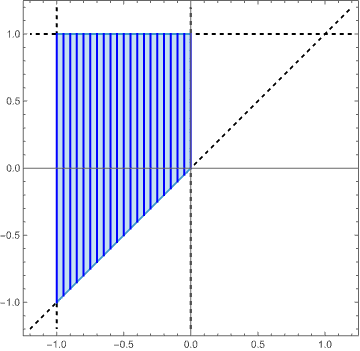
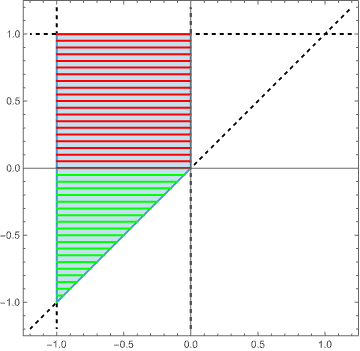
The volume is \(\frac{5}{2}\). Is it easier to hold \(x\) constant first or \(y\) constant first?
We can use Mathematica to compute integrals over non-rectangular regions as well:
Integrate[
  x + y,
  {x, 0, 1}, {y, 0, x^2}
]
This computes \(\int_0^1 \int_0^{x^2} (x+y) \, dy \, dx\).
Integrate[
  x^2 + y^2 + 1,
  {x, -1, 0}, {y, x, 1}
]
This computes \(\int_{-1}^0 \int_x^1 (x^2+y^2+1) \, dy \, dx\).
Remember: the inner variable should not appear in the outer integral limits—you know something has gone wrong in your setup if that happens!
Homework
- (Stewart, Clegg, and Watson 2020, sec. 15.1) #6, 15–18
- (Stewart, Clegg, and Watson 2020, sec. 15.2) #1–4