22 Double integrals II
Review of properties
If we can write \(R = R_1 \cup R_2\), where \(R_1\) and \(R_2\) are regions that don’t overlap (except maybe on their boundaries), then \[ \iint_R f(x,y) \, dA = \iint_{R_1} f(x,y) \, dA + \iint_{R_2} f(x,y) \, dA. \]
\[ \iint_R 1 \, dA = \mathrm{Area}(R). \]
Double integrals and partial derivatives
Recall the fundamental theorem of calculus: that integrals are anti-derivatives. There are two ways we might hope to generalize this to multi-variable calculus:
- Given a vector field \(\langle g(x,y), h(x,y) \rangle\), is there an \(f(x,y)\) such that \(\nabla f = \langle g, h \rangle\)? No.
- Can we relate volume under \(z = f(x,y)\) to \(f\) in terms of partial derivatives? Yes.
Suppose we are integrating a function \(f(x,y)\). Consider \[ F(x,y) = \int_a^x \int_c^y f(s,t) \, dt \, ds, \] the volume under \(z = f(x,y)\) over the region \([a,x] \times [c,y]\). If we set \(g(s,y) = \int_c^y f(s,t) \, dt\), then \[ \frac{\partial F}{\partial x} = \frac{\partial}{\partial x} \int_a^x g(s,y) \, ds = g(x,y) = \int_c^y f(x,t) \, dt, \] by the fundamental theorem of calculus. We eliminated one of the integrals! Moreover, \[ \frac{\partial}{\partial y} \frac{\partial F}{\partial x} = \frac{\partial}{\partial y} \int_c^y f(x,t) \, dt = f(x,y), \] again by the fundamental theorem. Hence, \(\frac{\partial^2 F}{\partial y \partial x} = f(x,y)\).
Moreover, the fact that \(\frac{\partial^2 F}{\partial y \partial x} = \frac{\partial^2 F}{\partial x \partial y}\) (Clairaut’s theorem) is dual to the fact that we could have interchanged the order of the integrals in defining \(F\) (Fubini’s theorem). These are the same theorem!
More examples
The region of interest is:
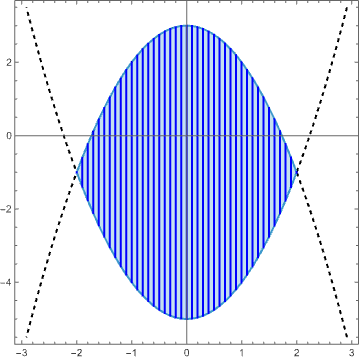
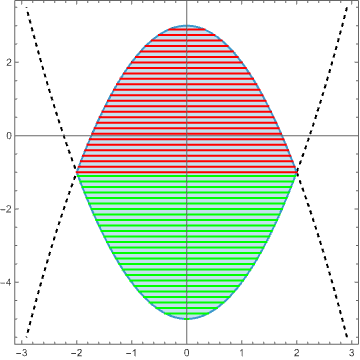
The integral, which works out to \(0\) volume, can be evaluated in two ways: \[ \begin{split} \iint_R x(y-1) \, dA & = \int_{-2}^2 \int_{x^2-5}^{3-x^2} x(y-1) \, dy \, dx \\ & = \int_{-1}^3 \int_{-\sqrt{3-y}}^{\sqrt{3-y}} x(y-1) \, dx \, dy + \int_{-5}^{-1} \int_{-\sqrt{y-5}}^{\sqrt{y-5}} x (y-1) \, dx \, dy. \end{split} \]
Which would you rather evaluate?
Much like integrals in one variable, the volumes \(\iint_R f(x,y)\) are signed.
The region of interest is:
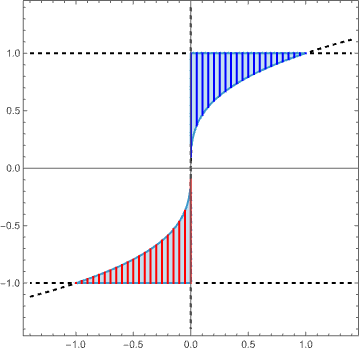
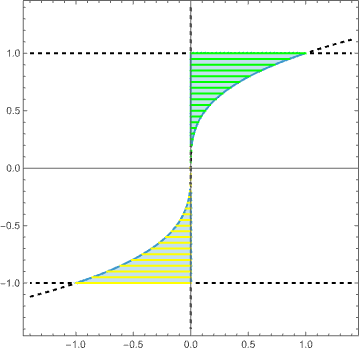
We have: \[ \begin{split} \iint_R e^{y^4} \, dA & = \int_0^1 \int_{\sqrt[3]{x}}^1 e^{y^4} \, dy \, dx + \int_{-1}^0 \ \int_{-1}^{\sqrt[3]{x}} e^{y^4} \, dy \, dx \\ & = \int_0^1 \int_0^{y^3} e^{y^4} \, dx \, dy + \int_{-1}^0 \ \int_{y^3}^0 e^{y^4} \, dx \, dy. \end{split} \] We can only evaluate one of these! Try it for yourself—the volume is \(\tfrac{e-1}{2}\).
Homework
(Stewart, Clegg, and Watson 2020, sec. 15.2) #7–8, 12–13, 23, 29